

Porcelain Veneers in Melbourne: What They Cost, How They're Made, and How Long They Last

Considering porcelain veneers but unsure what they really cost in Melbourne, what the process actually involves, and how long a good set should last? This guide walks through the clinical, financial, and longevity questions our patients ask most often — in plain language, with $AUD figures and Australian private-health-fund context throughout.
Porcelain Veneers in Melbourne: What They Cost, How They're Made, and How Long They Last
A porcelain veneer is one of the most discussed cosmetic treatments in Australian dentistry — and one of the most misunderstood. Patients often arrive at our centre with a screenshot from social media and a single question: what would this actually cost me, and is it worth it?
The honest answer depends on your enamel, your bite, your goals, and the artistry of the lab. We'll cover all of that below — and we'll be specific about Melbourne pricing, HICAPS rebates, and the realistic lifespan of a well-planned set.
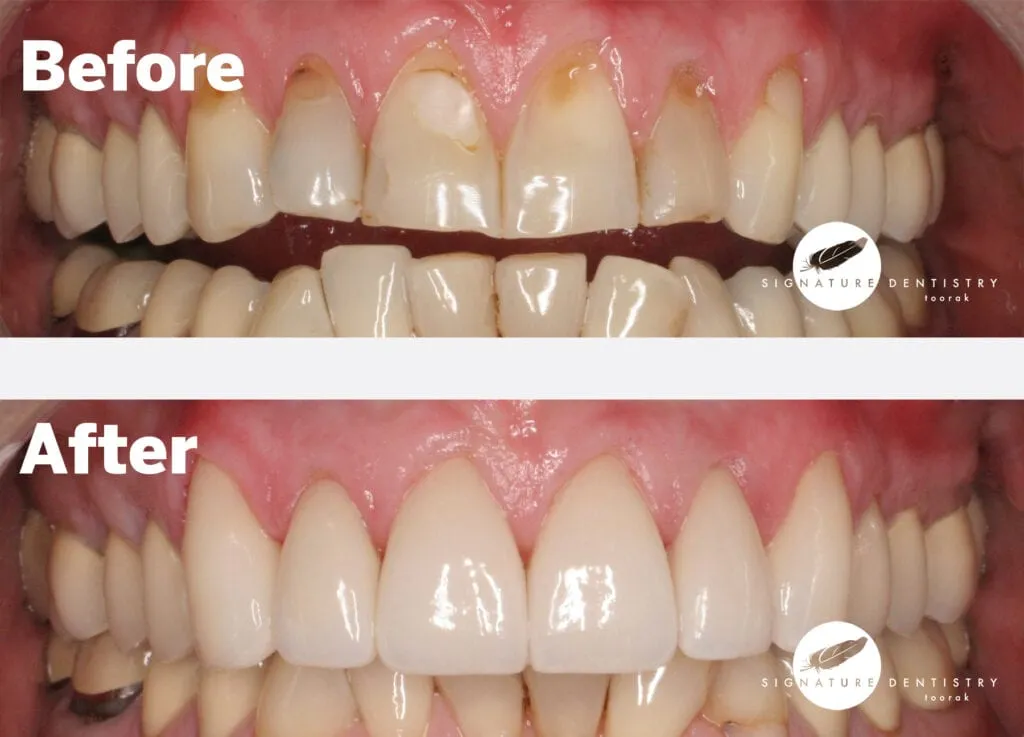
What Is A Porcelain Veneer, Exactly?
A porcelain veneer is a thin, custom-fired ceramic shell — usually 0.3 mm to 0.7 mm thick — that is bonded to the front surface of a tooth. The goal is to reshape, recolour, or realign the visible portion of the tooth without crowning it.
Done well, the veneer reads as enamel because it behaves like enamel — refracting light through translucent layers rather than sitting on the tooth like paint.
Why Do Patients Choose Veneers Over Whitening Or Crowns?
Whitening lifts colour but cannot change shape, edge wear, or chips. Crowns change everything but require far more tooth reduction and are usually overkill for a purely aesthetic concern.
Veneers occupy the middle ground — meaningful aesthetic change with conservative preparation. If you are weighing the alternatives, our guide to professional teeth whitening in Melbourne is a useful comparison, and our overview of porcelain dental crowns in Melbourne explains when a crown is the more appropriate restoration.
How Common Are Porcelain Veneers In Australia?
The Australian Dental Association has noted a steady rise in cosmetic enquiries since 2018, and porcelain veneers consistently sit in the top three procedures requested by patients aged 25–55. In our own Melbourne practice, veneer consultations have roughly doubled over the past four years.
That growth has a downside. Demand has pulled in operators offering rapid "smile makeovers" abroad and discounted in-house composite alternatives — and we routinely see the consequences when those choices fail prematurely.
Melbourne Cost Breakdown — What You're Actually Paying For
The per-tooth figure that most clinics quote bundles four distinct cost centres. Understanding the split helps you interpret why two quotes can differ by thousands of dollars.
| Cost component | Typical share | What it covers |
|---|---|---|
| Ceramist & lab fees | 30–40% | Hand-layered porcelain, custom shade matching, lab time |
| Clinical chair time | 25–30% | Preparation, impressions, bonding, occlusal refinement |
| Diagnostics & planning | 10–15% | Photography, digital scans, wax-up, mock-up trial smile |
| Materials & overheads | 20–25% | Bonding agents, isolation, sterilisation, warranty provision |
Will My Private Health Fund Or HICAPS Help Cover Veneers?
Cosmetic veneers placed purely for appearance are generally not claimable. However, when veneers are restoring fractured, eroded, or congenitally malformed teeth, your major dental extras cover may contribute meaningfully.
HICAPS will swipe your card on the day and apply any eligible rebate immediately. Most patients with top-tier extras see between $400 and $1,200 returned per restored tooth, capped by their annual major-dental limit.
How Are Porcelain Veneers Made? The Step-By-Step Process
A well-planned veneer case in our centre takes three to four appointments across roughly four to six weeks. Rushing this sequence is the most common reason veneer cases disappoint, so we resist it.

Does Getting Veneers Hurt?
The preparation appointment is performed under local anaesthesia and is comfortable for the overwhelming majority of patients. Mild sensitivity to cold for two to four weeks afterwards is normal as the dentine settles.
If you have significant dental anxiety, sedation options are available — we'll discuss these openly during your consultation rather than as an afterthought.
How Long Do Porcelain Veneers Last?
Published longevity data from the Australian Dental Association and international literature places well-bonded porcelain veneers at a 10–15 year median lifespan, with many cases extending to 20 years or more. Our own patient records track closely with that range.
The variables that move the number are not glamorous — they are bite force, hygiene, nightguard compliance, and avoiding habits like nail-biting and ice-chewing.
| Factor | Effect on lifespan |
|---|---|
| Nightguard worn nightly (if grinding) | Adds an estimated 5–8 years |
| Twice-yearly hygiene visits | Adds an estimated 3–5 years |
| Untreated bruxism | Reduces lifespan by 40–60% |
| Smoking | Stains margins; reduces aesthetic life by 30% |
| Acidic diet (citrus, soft drink, wine) | Erodes bonded margins over time |
Are You A Suitable Candidate For Porcelain Veneers?
Suitability is a clinical question, not a marketing one. The strongest candidates have healthy gums, sufficient enamel for bonding, a stable bite, and realistic expectations about colour and shape change.
If you have active decay, significant gum disease, or untreated bruxism, those issues are addressed first — sometimes alongside wisdom teeth assessment in Melbourne or other foundational care — before any cosmetic work begins.
What If I Don't Like Them After They're Bonded?
This is the question patients are most afraid to ask, and it's the most important one. The answer is the trial smile. Our protocol requires you to wear and approve the proposed shape in temporary composite before the porcelain is fabricated.
Once bonded, porcelain veneers are not removable in the way a temporary is. That is precisely why we invest the diagnostic time we do — the trial smile is your veto.
Definitions And Background Information On Porcelain Veneers
What is the difference between porcelain and composite veneers?
Porcelain veneers are fabricated in a lab from layered ceramic and bonded as a single shell. Composite veneers are sculpted directly on the tooth in resin during a single appointment. Porcelain costs more, looks more natural, and lasts roughly three times longer.
Do veneers ruin your teeth?
Properly planned veneers do not ruin teeth. Conservative preparation removes a thin layer of enamel — usually less than a millimetre — and the bonded porcelain protects the surface. Aggressive over-preparation by inexperienced operators is what creates problems.
Can veneers be whitened?
No. Porcelain does not respond to whitening agents. If you plan to whiten your remaining natural teeth, do so before veneers are colour-matched and placed.
Are veneers tax-deductible in Australia?
Generally no, as cosmetic dental work is not claimable as a medical expense in Australia. Restorative components may attract a private-health-fund rebate as discussed above. Speak with your accountant for your specific circumstances.
How do I look after veneers day-to-day?
Brush twice daily with a non-abrasive toothpaste, floss carefully around the bonded margins, attend hygiene visits every six months, and wear your nightguard if one was prescribed. Avoid biting hard objects.
Find Out If Porcelain Veneers Are Right For You — Book A Consultation In Melbourne
Veneers are a significant decision, and the right way to evaluate them is in the chair with photographs, scans, and an honest conversation about what your teeth and your goals can support. We welcome the opportunity to walk you through that.
Phone our Melbourne centre on +61 3 9826 1338, or Book a consultation. You can also reach us through our contact page if you'd prefer to send your questions in writing first.
This article is for informational purposes and does not constitute medical or dental advice. Consult a qualified dentist about your specific situation.
FAQ
Porcelain veneers are fabricated in a lab from layered ceramic and bonded as a single shell. Composite veneers are sculpted directly on the tooth in resin during a single appointment. Porcelain costs more, looks more natural, and lasts roughly three times longer.
Properly planned veneers do not ruin teeth. Conservative preparation removes a thin layer of enamel — usually less than a millimetre — and the bonded porcelain protects the surface. Aggressive over-preparation by inexperienced operators is what creates problems.
No. Porcelain does not respond to whitening agents. If you plan to whiten your remaining natural teeth, do so before veneers are colour-matched and placed.
Generally no, as cosmetic dental work is not claimable as a medical expense in Australia. Restorative components may attract a private-health-fund rebate as discussed above. Speak with your accountant for your specific circumstances.
Brush twice daily with a non-abrasive toothpaste, floss carefully around the bonded margins, attend hygiene visits every six months, and wear your nightguard if one was prescribed. Avoid biting hard objects.

Meet cosmetic dentist
Dr Kasen Somana & team
The standard for compassion, care, and comfort begin here.
Honours graduate of the University of Sydney. Masters in Aesthetic Dentistry from King's College London.
Meet Dr Kasen Somana ›
521 Toorak Rd, Toorak
Fri – Sun: Closed