
Dental Crowns in Melbourne: What They Cost, How They're Made, and How Long They Last

Have you recently been told you need a dental crown and found yourself wondering exactly what that involves, what it will cost, and how long it will actually last? You are far from alone — crowns are now the second most-searched restorative procedure in metro Melbourne after veneers, and the questions we hear at the chair almost always cluster around the same three concerns.
That said, the good news is that the answers are far more concrete than most patients expect. The cost range is well-established, each material has specific strengths, and longevity outcomes are well-documented across decades of clinical research.
This guide walks through what a crown actually is, why you might need one, and how much you should expect to pay across Melbourne. We will also cover how the major materials — zirconia, lithium disilicate (e.max), and porcelain-fused-to-metal — stack up over a 10 to 20 year horizon, what your private health fund will and will not cover, and what the appointment itself looks like end to end.
What Is A Dental Crown, Exactly?
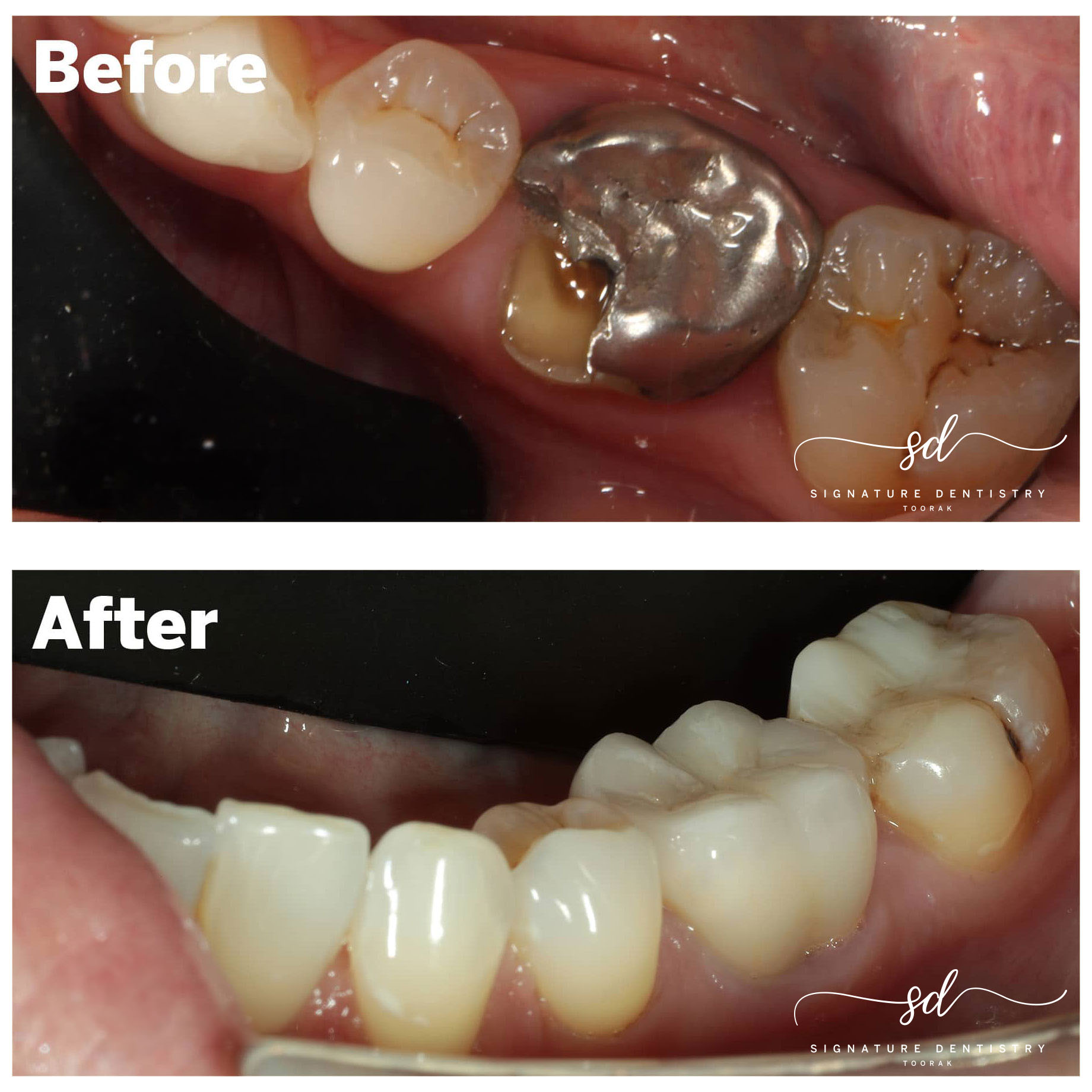
Think of a crown as a tailored helmet for a tooth that has lost too much of its original structure to be safely filled. Where a filling rebuilds a small portion of a tooth, a crown wraps the entire visible surface above the gum line in a single continuous shell.
That continuous shell is what makes crowns so effective at protecting compromised teeth from cracks, fractures, and further decay. Modern crowns are also designed to mimic the colour, translucency, and gloss of natural enamel, so a well-made crown is rarely visible to anyone except your dentist.
Why Would I Need A Crown In The First Place?
There are a handful of clinical situations where a crown is the right call rather than a filling, an inlay, or simply leaving the tooth alone. Indications include but are not limited to:
- After a root canal. The remaining tooth is brittle and benefits enormously from the protective wrap of a crown to prevent vertical fracture.
- To cover a large, deep restoration. When a filling would replace more than around half of the tooth's biting surface, the long-term prognosis improves significantly with full coverage.
- To repair a cracked or fractured tooth. Crowns redistribute biting forces away from the fracture line and can prevent the crack from propagating into the root.
- To restore a heavily worn tooth. Patients who grind or clench frequently see significant enamel loss, and crowns rebuild the lost vertical height.
- To finish a dental implant. Implants require a crown on top to function as a working tooth.
- For cosmetic correction. Crowns can also reshape and recolour a tooth too discoloured, misshapen, or worn for veneers alone — though we always sequence whitening first, since crown porcelain cannot be bleached later.
Keep in mind that the line between "needs a crown" and "could get away with a filling" is genuinely judgement-based. Your dentist should walk you through both options, including expected longevity, before committing to a crown.
How Common Are Crowns In Melbourne?
Crowns are one of the most frequently performed restorative procedures across Australia. Annual practice surveys suggest that crown and bridge work makes up approximately 8 to 12 per cent of all clinical chair time in private general practice.
In metro Melbourne specifically, the volume skews higher than the national average. This is partly because of an older population in inner-suburban catchments, and partly because cosmetic-led practices serve a higher proportion of patients seeking smile design work that combines crowns with whitening and veneers.
For context on the broader cosmetic landscape, our piece on professional teeth whitening in Melbourne covers how whitening fits into a sequenced restorative plan — and why it almost always happens before crown work, never after.
How Much Does A Dental Crown Cost In Melbourne?
Pricing in metro Melbourne is more consistent than most patients realise, particularly across cosmetic-focused practices. A useful way to think about the cost is to break it into three components — the dentist's chair time, the laboratory fee, and the material itself.
Standard option for back teeth where appearance matters less than mechanical strength.
The modern workhorse — exceptional strength and a natural-enough finish for most positions.
Premium translucency for front teeth where colour-matching is the priority.
Rare in cosmetic practice but unmatched for longevity in deep posterior positions.
It is worth being aware that quoted figures should always include the laboratory fee, the cementation appointment, and the temporary crown you will wear in between. Practices that quote a low headline figure and then add lab fees on top tend to land in the same range once everything is totalled.
Note that any underlying treatment — for instance a root canal or a core build-up before the crown — will be charged separately. We always provide a written quote before any restorative work begins.
Zirconia, E.max, Or Porcelain-Fused-To-Metal?

Material choice is genuinely the most important conversation you will have with your dentist about a crown. Each material has a clear sweet spot, and using the wrong one in the wrong position is the single most common reason crowns fail prematurely.
| Material | Best For | Strength | Aesthetics | Typical Lifespan |
|---|---|---|---|---|
| Zirconia | Molars and premolars | Highest | Good | 15 – 25+ years |
| Lithium Disilicate (e.max) | Front teeth, smile zone | High | Excellent | 10 – 20 years |
| Porcelain-Fused-To-Metal | Posterior teeth, bridges | High | Moderate | 10 – 15 years |
| Full Gold Alloy | Out-of-sight molars, bruxers | Very High | Low (gold colour) | 20 – 40 years |
Zirconia has effectively become the default choice for back teeth across modern Australian practice. It tolerates heavy biting forces, is highly resistant to fracture, and the latest generation of multi-layered zirconia delivers acceptable translucency even in semi-visible positions.
For front teeth, however, e.max remains our preferred option. The translucency of lithium disilicate sits closer to natural enamel than any other ceramic, which matters enormously when a single crown sits next to a row of natural teeth.
Porcelain-fused-to-metal still has a role, particularly in long-span bridges where the metal substructure provides additional rigidity. The trade-off is that the metal margin can show as a dark line at the gum if your gums recede over time.
Lab-Made Versus Chairside CEREC Crowns
Beyond material, the other major decision is whether your crown is fabricated by a dental laboratory over one to two weeks, or milled chairside on the day using a CEREC unit. Both approaches produce excellent results in the right hands.
Lab-made crowns generally allow for more nuanced colour layering and surface characterisation, which is why we still send most front-tooth e.max work to specialist ceramicists. The trade-off is two appointments separated by a fortnight of wearing a temporary crown.
Chairside CEREC crowns are milled from a solid ceramic block in a single visit, meaning you walk out with the final crown bonded the same afternoon. CEREC excels for monolithic zirconia and lithium disilicate molar crowns where complex layering is not the priority.
How Long Will Your Crown Actually Last?
Average lifespans hide an enormous amount of variation. The same crown material in a careful patient with a balanced bite will outlast a crown in a heavy bruxer by a factor of two or three.
The clearest way to compare expected longevity is by material, assuming routine care and no underlying decay or trauma. The bars below reflect typical clinical performance for crowns placed in metro Melbourne general practice.
Remember that the underlying tooth ages too. Even the world's best crown will eventually fail if the supporting tooth develops decay at the margin or the surrounding gum recedes significantly.
This is why six-monthly check-ups matter more for crowned teeth than uncrowned ones. We are checking the crown, but we are also checking the join between crown and tooth — which is where almost every long-term failure begins.
What Does Your Private Health Fund Actually Cover?
Crowns sit under the major dental category for almost every Australian private health insurer. That category typically carries a 12-month waiting period for new policies and a separate annual limit from your general dental cover.
The practical implication is that a crown placed in the second half of the calendar year may benefit from staging — for instance, the preparation appointment in December and the cementation in January, drawing from two separate annual limits. We are happy to coordinate this with your fund where it works in your favour.
HICAPS is on every chairside terminal in our practice. Your rebate is processed instantly, so you only ever pay the gap on the day rather than waiting for a fund reimbursement.
Note that Medicare does not subsidise crown work for adults outside very specific circumstances. The Child Dental Benefits Schedule does cover certain restorative work for eligible children up to age 17, but crowns rarely fall within that scope.
What Does The Crown Process Look Like, Step By Step?
Initial Consultation And Diagnostic Imaging
We assess the tooth, take digital scans and X-rays, and confirm whether a crown is the right call versus a filling or onlay. You leave with a written quote and a clear timeline.
Tooth Preparation Under Local Anaesthesia
The tooth is gently reshaped to allow space for the crown. We use careful local anaesthesia and modern slow-speed instrumentation, so the appointment is genuinely comfortable.
Digital Impression And Shade Match
An intra-oral scanner captures the prepared tooth in three dimensions. If you are also considering brightening, our guide on how Melbourne whitening sequencing works explains why we always whiten first.
Temporary Crown Placement
For lab-made crowns, a temporary crown protects the tooth for the one-to-two-week fabrication window. Chairside CEREC crowns skip this step entirely.
Final Cementation And Bite Adjustment
The final crown is bonded with a resin cement, your bite is checked from every angle, and we polish the margins. Most patients are eating normally within a couple of hours.
The whole sequence typically spans two to three weeks for lab-made crowns and a single morning for chairside CEREC. Either way, you should leave the final appointment with a tooth that feels like your own.
How Do You Make A Crown Last Longer?
The single biggest predictor of crown longevity is whether you grind or clench. Patients with significant bruxism almost always benefit from a custom occlusal splint worn at night, which protects both the crown and the surrounding teeth.
Beyond that, the everyday rules are unsurprising — twice-daily brushing with a fluoride toothpaste, daily flossing or interdental brushing around the crown margin, and six-monthly professional cleans. The crown itself cannot decay, but the underlying tooth absolutely can.
If you would like a broader view of how we approach long-term restorative planning, our welcome note from the Signature Dentistry team walks through the philosophy behind sequenced cosmetic and restorative care.
Frequently Asked Questions
Does getting a crown hurt?
No — the preparation appointment is performed under local anaesthesia and is comparable to having a large filling placed. Most patients describe the cementation appointment as effectively painless, since the tooth is already shaped and there is no drilling involved.
How long does the appointment take?
The preparation appointment usually runs 60 to 90 minutes, depending on the tooth and how much existing restoration needs to be removed. Chairside CEREC crowns add roughly 45 minutes for milling and cementation in the same visit.
Can I eat normally with a temporary crown?
You can eat with a temporary, but we ask you to avoid sticky lollies, chewy bread, and hard nuts on that side until the final crown is bonded. The temporary cement is designed to release cleanly when the final crown is ready.
What if my crown comes loose or falls off?
Keep the crown safe and book in to see us as soon as practical — same day if possible. Do not attempt to glue it back yourself with household adhesives, as this can damage the underlying tooth and prevent proper recementation.
Are crowns covered by Medicare?
Crown work is not covered under standard Medicare for adults in Australia. The Child Dental Benefits Schedule may cover limited restorative work for eligible children, but adult crowns are funded through private health extras, payment plans, or out-of-pocket.
Is a crown reversible?
No — preparing a tooth for a crown removes a layer of enamel and dentine that cannot be replaced. This is why we always discuss whether a less invasive option, such as a large composite filling or an onlay, might serve you equally well first.
Can a crown be replaced if I dislike the colour or shape?
Yes, although we work hard to get colour and shape right the first time using digital design previews and try-in stages where appropriate. Replacing a crown after final cementation is technically possible but does involve a fresh laboratory fee.
Book Your Crown Consultation In Melbourne
If you have been told you need a crown — or you simply suspect a tooth is on its way to needing one — the right move is a thorough diagnostic appointment before anything else. We will walk you through every option, including the option of not crowning at all where that genuinely makes sense.
To book directly, please use our online booking page or call our practice on +61 3 9826 1338. You can also reach us through the contact form if you would prefer to send your X-rays or treatment quotes for a written second opinion.
FAQ
No — the preparation appointment is performed under local anaesthesia and is comparable to having a large filling placed. Most patients describe the cementation appointment as effectively painless, since the tooth is already shaped and there is no drilling involved.
The preparation appointment usually runs 60 to 90 minutes, depending on the tooth and how much existing restoration needs to be removed. Chairside CEREC crowns add roughly 45 minutes for milling and cementation in the same visit.
You can eat with a temporary, but we ask you to avoid sticky lollies, chewy bread, and hard nuts on that side until the final crown is bonded. The temporary cement is designed to release cleanly when the final crown is ready.
Keep the crown safe and book in to see us as soon as practical — same day if possible. Do not attempt to glue it back yourself with household adhesives, as this can damage the underlying tooth and prevent proper recementation.
Crown work is not covered under standard Medicare for adults in Australia. The Child Dental Benefits Schedule may cover limited restorative work for eligible children, but adult crowns are funded through private health extras, payment plans, or out-of-pocket.
No — preparing a tooth for a crown removes a layer of enamel and dentine that cannot be replaced. This is why we always discuss whether a less invasive option, such as a large composite filling or an onlay, might serve you equally well first.
Yes, although we work hard to get colour and shape right the first time using digital design previews and try-in stages where appropriate. Replacing a crown after final cementation is technically possible but does involve a fresh laboratory fee.

Meet cosmetic dentist
Dr Kasen Somana & team
The standard for compassion, care, and comfort begin here.
Honours graduate of the University of Sydney. Masters in Aesthetic Dentistry from King's College London.
Meet Dr Kasen Somana ›
521 Toorak Rd, Toorak
Fri – Sun: Closed