
Wisdom Teeth Removal in Melbourne: When It's Necessary, What It Costs, and What Recovery Actually Looks Like

Few dental phrases land with quite the same low-grade dread as your wisdom teeth need to come out. It is one of the most-searched dental questions in Melbourne metro, and yet most of what people read online is either a brochure for a clinic on the other side of the world or a horror story from a friend of a friend.
This guide is written from the chair — what we actually see in Toorak and across the south-eastern suburbs, what the procedure costs in $AUD when HICAPS and private health funds are factored in, and what the first ten days really look like. Read on if you want the clinical version, not the marketing one.
No. Wisdom teeth that are fully erupted, in good position, easy to clean, and not crowding adjacent molars can stay. Removal is recommended when teeth are impacted, partially erupted, decayed, causing recurrent pericoronitis, or contributing to cyst formation or damage to the second molar. The decision is clinical, not automatic.
Why Wisdom Teeth Cause So Much Trouble In The First Place
Third molars are evolutionary leftovers. The modern human jaw is, on average, smaller than it was a few thousand years ago — and the result is that there is often simply not enough room at the back of the arch for a fourth molar to erupt cleanly.
When that space is missing, the tooth either pushes against the second molar, breaks through the gum at an angle, or stays trapped in bone altogether. That is when symptoms start.
How Common Are Wisdom Teeth Problems In Australian Adults?
Estimates from the Australian Institute of Health and Welfare and clinical literature suggest that roughly 70–85% of Australian adults will have at least one wisdom tooth that does not erupt into a functional, cleanable position. A meaningful share of those teeth will eventually need to come out.
That said, prevalence is not destiny. Plenty of patients live their entire lives with retained third molars that never cause a problem — which is exactly why we monitor rather than reflexively extract.
A straightforward erupted wisdom tooth removed under local anaesthetic typically ranges from $250 to $450 $AUD per tooth. A surgically impacted tooth requiring sectioning sits between $450 and $750. Full general-anaesthetic cases for all four wisdom teeth in hospital generally range from $2,500 to $4,500 before private health fund rebates.
When Removal Is Actually Necessary
We recommend removal when the clinical picture clearly favours it. The list is shorter than most patients expect.
- Recurrent pericoronitis. The gum flap over a partially erupted tooth keeps becoming infected, painful, or swollen — often more than twice in a year.
- Decay or periodontal damage to the second molar. A tilted wisdom tooth traps plaque against the tooth in front, and that neighbour starts to suffer.
- Cysts or pathology. Imaging shows a dentigerous cyst, follicular enlargement, or a lesion associated with the unerupted crown.
- Non-restorable decay in the wisdom tooth itself. The tooth is too far back to restore predictably and is breaking down.
- Orthodontic or prosthodontic planning. A treatment plan requires the space, or the tooth interferes with planned restorative work.
Notably absent from that list is prevention of crowding of the front teeth. The evidence for prophylactic removal on those grounds alone is weak, and we do not recommend it on that basis.
What The Consultation Looks Like
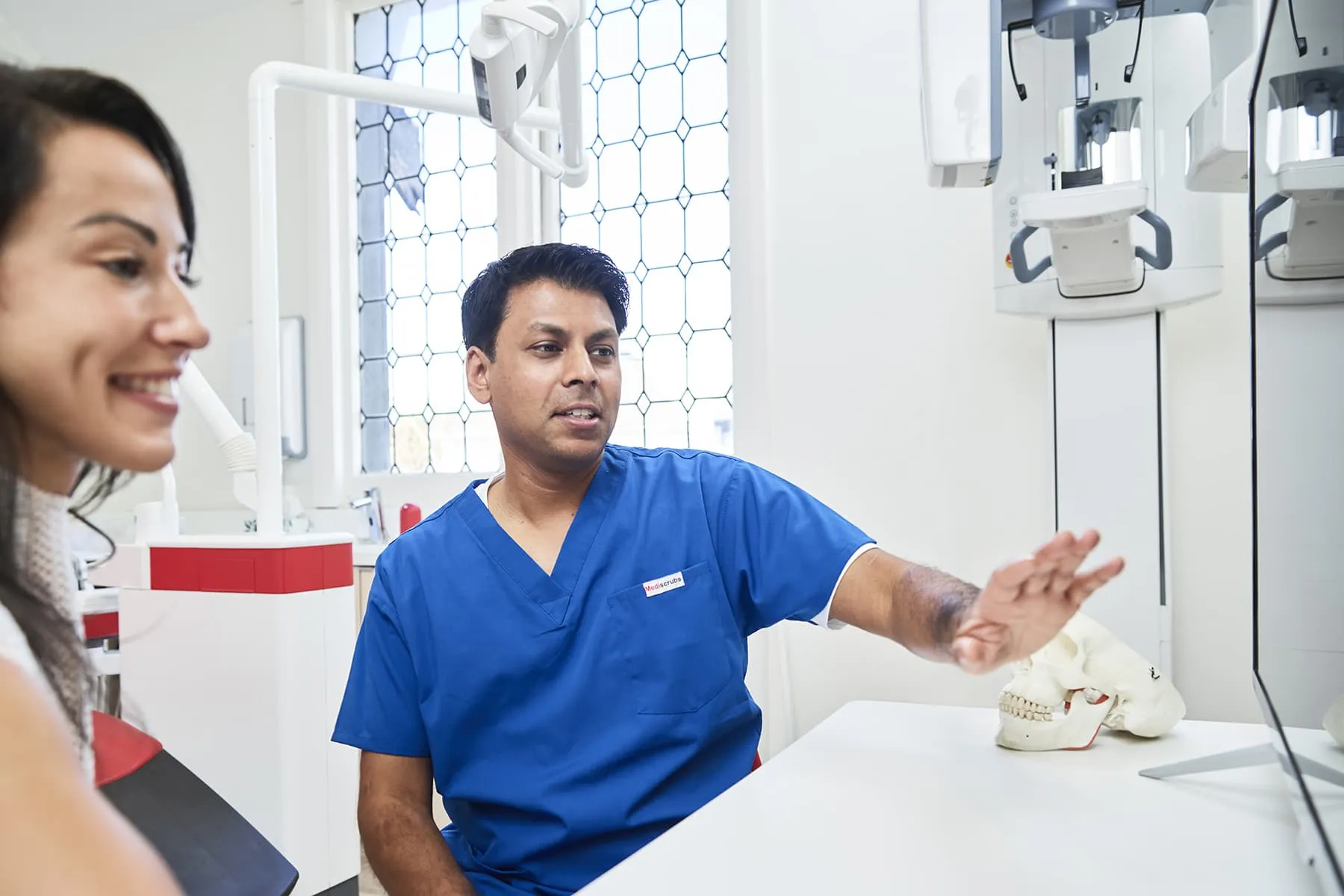
A proper wisdom tooth consultation involves clinical examination, an OPG (panoramic X-ray), and — for anything close to the inferior alveolar nerve — a CBCT scan to map the nerve canal in three dimensions. We will not quote a surgical fee without imaging.
Risk discussion is part of consent, not a sales pitch. Lower wisdom teeth carry a small but real risk of temporary or, rarely, permanent altered sensation of the lip, chin, or tongue, and that risk is one of the things CBCT imaging exists to quantify before we operate.
Local, Sedation, Or General — How To Choose
The choice of anaesthetic depends on the difficulty of the case, the number of teeth being removed in one visit, and how anxious the patient is. There is no single right answer.
| Approach | Best for | Typical cost ($AUD, before rebates) |
|---|---|---|
| Local anaesthetic in the chair | 1–2 erupted teeth, low anxiety | $250–$750 per tooth |
| IV sedation (twilight) | Multiple teeth, moderate anxiety, awake but relaxed | $1,200–$2,400 total |
| General anaesthetic in hospital | All four impacted, high anxiety, complex anatomy | $2,500–$4,500 total |
If anxiety is the main barrier, sedation often changes the conversation entirely — see our piece on how we approach nervous patients at Signature Dentistry for the broader philosophy.
What Health Funds And HICAPS Actually Cover
This is the question we get asked most, and the honest answer is: it depends on your level of cover. Major dental on most extras policies will partially rebate item numbers 314, 322, 323, and 324 (the relevant ADA codes for surgical removal), with annual limits typically between $1,000 and $2,500 per person.
For hospital-based general-anaesthetic cases, your hospital cover handles the theatre and anaesthetist fees, while your extras cover handles the dental component. We process HICAPS in the chair so you only pay the gap on the day.
Medicare does not cover routine wisdom teeth removal. The Child Dental Benefits Schedule covers eligible children up to $1,095 over two years, and public hospital pathways exist for severe surgical cases. Otherwise, costs are met through private health fund extras, hospital cover, or out-of-pocket. HICAPS allows on-the-spot claiming with most major funds.
The Procedure, Step By Step
What Recovery Actually Looks Like — Day By Day
Brochures tend to compress recovery into one cheerful sentence. The reality is more textured, and being prepared for each phase makes the whole thing easier to navigate.
Most patients return to desk-based work within 3–5 days and to full normal activity within 7–10 days. Swelling peaks at 48 hours, then steadily improves. Bony remodelling of the socket continues for 3–6 months, but you will not feel it. Strenuous exercise should be paused for the first week to reduce bleeding risk.
Complications, Honestly Discussed
Most wisdom tooth surgeries heal uneventfully. The complications worth knowing about are dry socket, infection, prolonged bleeding, and altered nerve sensation — and each has a manageable response if it occurs.
Dry socket is the most common, affecting roughly 2–5% of routine removals and a higher percentage of lower impacted teeth. It is treated in the chair with irrigation and a medicated dressing, and it resolves predictably.
How To Make Recovery Easier — The Practical List
- Stock the fridge before surgery. Yoghurt, smoothies, mashed potato, soup, scrambled eggs, custard.
- No straws for a week. Suction is the leading mechanical cause of dry socket.
- Sleep slightly elevated for two nights. An extra pillow reduces overnight swelling.
- Take pain relief on a schedule. Staying ahead of pain is far more comfortable than chasing it.
- Skip alcohol, smoking, and vigorous exercise for 7 days. All three meaningfully increase bleeding and infection risk.
Linked Reading From Our Practice
If you are weighing wisdom teeth removal alongside other planned work, our existing pieces on dental crowns in Melbourne and teeth whitening in Melbourne will help you sequence treatment sensibly. Surgical work generally goes first, then restorative, then aesthetic — and that order matters more than most patients realise.
Frequently Asked Questions
Can I drive myself home after wisdom teeth removal?
Yes after local anaesthetic only. After IV sedation or general anaesthetic, you must arrange a responsible adult to drive you and ideally stay with you for the first night.
What if only one wisdom tooth is causing problems — should I remove all four?
Not automatically. We remove what is clinically indicated. If the other three are well-positioned and healthy, we monitor them.
How soon can I go back to work?
Most patients with desk jobs return on day 3 or 4. Physically demanding work generally needs 5–7 days off.
Will my face be visibly swollen?
Expect mild to moderate cheek swelling for 3–5 days, peaking at 48 hours. It resolves predictably and is reduced significantly by good icing in the first 24 hours.
Is it normal to taste blood for a few days?
Yes. A faint metallic taste and pink-tinged saliva for 2–3 days is normal. Active red bleeding that soaks gauze repeatedly is not — call us.
Book A Wisdom Teeth Consultation In Melbourne
If you are weighing whether your wisdom teeth need to come out — or you have been told they do and want a second opinion before committing — a single consultation with imaging will give you a clear, honest picture of what is and is not necessary.
You can Book A Consultation online, reach us through our contact page, or call the practice directly on +61 3 9826 1338. We will explain the imaging, the options, and the costs in plain language, and we will not recommend surgery you do not need.
FAQ
Yes after local anaesthetic only. After IV sedation or general anaesthetic, you must arrange a responsible adult to drive you and ideally stay with you for the first night.
Not automatically. We remove what is clinically indicated. If the other three are well-positioned and healthy, we monitor them.
Most patients with desk jobs return on day 3 or 4. Physically demanding work generally needs 5–7 days off.
Expect mild to moderate cheek swelling for 3–5 days, peaking at 48 hours. It resolves predictably and is reduced significantly by good icing in the first 24 hours.
Yes. A faint metallic taste and pink-tinged saliva for 2–3 days is normal. Active red bleeding that soaks gauze repeatedly is not — call us.

Meet cosmetic dentist
Dr Kasen Somana & team
The standard for compassion, care, and comfort begin here.
Honours graduate of the University of Sydney. Masters in Aesthetic Dentistry from King's College London.
Meet Dr Kasen Somana ›
521 Toorak Rd, Toorak
Fri – Sun: Closed